Published by November 30, 2025 · Reading time 22 minutes · Created by Lix.so
The simplest way to think about this is impressions are views, and clicks are actions. One tells you how many people laid eyes on your ad, while the other tells you how many were interested enough to engage with it. Getting this distinction right is the very first step toward building an advertising strategy that actually works.
In digital marketing, you live and die by your KPIs. At the ground level, impressions and clicks are the two pillars holding everything up. They answer two very different, but equally critical, questions: "Is anyone seeing my ad?" and "Is my ad good enough to make them do something?"
An impression gets counted every single time your ad loads on a user's screen. It doesn’t matter if they actually noticed it, lingered on it, or just scrolled past in a blur. If the pixels loaded, it’s an impression. Simple as that.
A click, however, is a deliberate choice. It’s someone seeing your ad and deciding they want to know more, prompting them to click through to your website, landing page, or app. This is an active signal of interest, moving a potential customer one step closer to a conversion.
The gap between impressions and clicks has been a core part of ad analytics for decades. You will always have far more impressions than clicks. Back in 2018, for example, the average click-through rate for display ads was a tiny 0.1%. That means for every 1,000 impressions, you got just one click. Search ads fared better with a 2% CTR, or 20 clicks per 1,000 impressions. You can dig into more advertising metrics on luccaam.com.
This massive difference is exactly why you need to know which metric to focus on for your specific campaign.
Takeaway: Impressions measure how wide your net is cast—think brand visibility and audience reach. Clicks measure how many fish you're catching—that’s active engagement and user intent. Neither is "better," their value is all about your goals.
To make it even clearer, let's put them side-by-side. This table gives you a quick rundown of how each metric works in the real world, from its primary goal to how you’ll typically pay for it.
| Metric | What It Measures | Primary Goal | Common Pricing Model |
|---|---|---|---|
| Impression | The total number of times an ad is displayed on a screen | Brand Awareness & Reach | CPM (Cost Per Mille/Thousand) |
| Click | The total number of user interactions with an ad | Lead Generation & Sales | CPC (Cost Per Click) |
Ultimately, impressions are about getting your name out there, while clicks are about getting people through the door. Knowing when to prioritize one over the other is what separates a good media buyer from a great one.
Impressions and clicks aren't isolated metrics; they're linked by one of the most important diagnostic tools in your arsenal: Click-Through Rate (CTR). Think of CTR as the bridge between visibility and genuine engagement. It tells you what percentage of people who saw your ad were interested enough to actually click on it.
The formula itself is beautifully simple, but it tells a powerful story. It cuts through the raw numbers of impressions and clicks to give you a single, actionable percentage that speaks volumes about your creative and targeting.
Calculating your CTR is straightforward. Just take the total number of clicks your ad got, divide it by the total number of impressions, and then multiply by 100 to express it as a percentage.
Let’s say your new Facebook ad campaign generated 500 clicks after being shown 20,000 times. Your CTR would be 2.5%. This means for every 100 people who saw your ad, about two or three clicked. That single number gives you an immediate pulse check on your ad's performance.
CTR is your first indicator of relevance. A strong CTR suggests that your ad copy, creative, and targeting are all working together to capture the attention of the right audience. It answers the question, "Is my message resonating?"
Here's the tricky part: there's no universal "good" CTR. It's wildly contextual and changes based on the platform, your industry, and even the ad format you're using.
Back in 2020, for example, the average CTR for Google Search Ads was around 3%, but display ads hovered at a much lower 0.6%. Social media was somewhere in the middle, with Facebook's average CTR across all industries sitting at about 0.9%. You can dig deeper into these digital marketing benchmarks and their importance to see how you stack up.
This data really underscores a key point in the impression vs. click debate: user intent is everything. Someone actively typing a search into Google is far more likely to click an ad than a person casually scrolling through their social feed.
While CTR is a vital health check, it’s not the final word on success. A high CTR doesn't automatically mean you're winning, and a low one isn't always a sign of failure. It all comes down to your campaign goals.
A high CTR can be a great sign, often pointing to:
But a high CTR can also be a red flag. For instance, if your ad copy is vague or borders on clickbait, you might get tons of clicks but see a massive bounce rate on your landing page. Those are low-quality clicks that burn through your ad spend without leading to conversions.
On the flip side, a low CTR isn't always a problem, especially for certain types of campaigns.
Ultimately, CTR is a diagnostic tool, not a final grade. Use it alongside metrics like conversion rate, cost per acquisition (CPA), and return on ad spend (ROAS) to build a complete picture of performance. It tells you if your ad is doing its job of getting the right people to knock on your door.
Choosing to focus on impressions isn't a sign of a weak campaign; it’s a deliberate, strategic move. While clicks give you that instant gratification of knowing someone engaged, there are plenty of times when maximizing raw visibility is the smarter play. This is especially true when you're paying by Cost Per Mille (CPM), where your budget goes toward getting seen by as many relevant people as possible.
This is all about playing the long game. The goal isn't to get a sale today. It's to become the brand someone instinctively thinks of tomorrow. Clicks are about immediate action, but impressions are about building mental real estate in your audience's mind.
When you're launching a new brand or product, your biggest enemy isn't a low click-through rate—it's obscurity. Before anyone can even think about clicking, they have to know you exist. This is where an impression-first strategy is king.
You need to saturate your target market with your name, logo, and message. The aim is to create familiarity and buzz so that when a potential customer is ready to buy, you're already a known quantity.
Here’s why impressions are your best friend at this stage:
In this scenario, a low CTR is perfectly fine and even expected. The real victory is the sheer volume of views that carves out your initial footprint in the market.
For a new brand, fighting for attention is the first and most important battle. Prioritizing impressions ensures you're seen, heard, and remembered when a future need arises.
Even well-known brands have to keep feeding the top of their marketing funnel. Top-of-funnel (ToFu) campaigns are all about reaching a wide audience that fits your ideal customer profile but isn't necessarily in buying mode yet.
Think of it as starting a conversation, not asking for a sale. A sustainable fashion brand, for instance, might run a campaign showcasing its ethical sourcing. The goal is to build an association between the brand and its values, not to move a specific t-shirt that day.
An impression-based strategy lets you reach a massive number of these potential customers without breaking the bank. Since you're paying for eyeballs instead of actions, your budget stretches further, maximizing your reach and brand message.
Remarketing is the classic case where impressions work wonders. Someone has already visited your website, so you know there’s a spark of interest. An impression-focused remarketing campaign keeps your brand front and center without being annoying.
The strategy here is a gentle, persistent reminder, not a hard sell. Research consistently shows that familiarity breeds liking. Seeing your ad a few more times can reinforce trust and keep your solution top-of-mind for when they're finally ready to pull the trigger. It's a subtle but powerful influence that often works better than an aggressive call-to-action, turning a past visitor into a future customer without feeling pushy. This is a critical distinction to remember in the impression vs. click debate.
When it's time for your campaign to drive immediate action, clicks become your north star. Unlike an impression-focused strategy that patiently builds long-term brand equity, prioritizing clicks is all about getting direct, tangible results right now. This approach is laser-focused on pushing high-intent traffic to a specific destination where a conversion is waiting to happen.
This means you're trading the CPM (Cost Per Mille) model for a CPC (Cost Per Click) model. With CPC, you only open your wallet when someone is interested enough to actually interact with your ad. It's a pure performance play that ties your ad spend directly to user engagement, making it perfect for campaigns where every dollar has to prove its worth with a measurable outcome.
A click-first strategy truly shines when your objective is crystal clear and demands a user to take that next step. If your goal is anything beyond simple brand awareness, you'll almost always want to generate quality clicks that pull users deeper into your funnel.
Think about these common scenarios where clicks are the undisputed priority:
In every one of these cases, the click isn't just a vanity metric; it’s the gateway to a conversion. You're specifically targeting users who are telegraphing a high level of intent with their actions.
When the path to conversion starts with a click, optimizing for anything else is a distraction. Your ad's job is to be so compelling that it earns that interaction, pulling a qualified prospect into your ecosystem.
The real power of a click-focused campaign is its direct, unbreakable link to business results. Every single click can be tracked, analyzed, and assigned a value. This makes calculating your return on ad spend (ROAS) far more straightforward because you can follow the user's journey from that initial click all the way to the final conversion.
To see the contrast, this diagram lays out when an impression-focused goal makes sense.
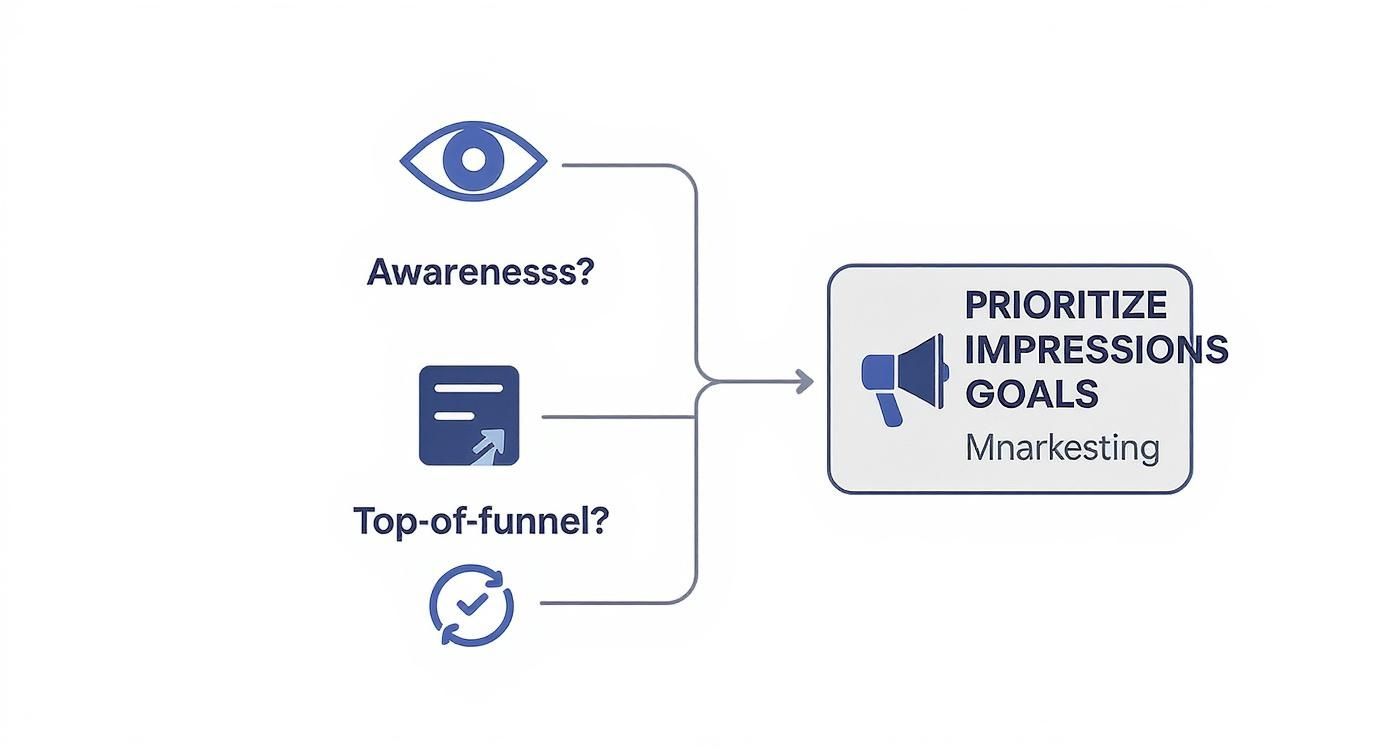
As the visual suggests, impressions are best for top-of-funnel goals like building awareness, whereas clicks are reserved for objectives that demand a direct response.
Of course, this strategy isn't without its own set of challenges. A big one is the risk of attracting low-quality traffic. Clicks from users who aren't genuinely interested can burn through your budget without ever leading to conversions. That’s why having a highly relevant landing page and crystal-clear ad messaging is non-negotiable—they act as a filter for casual clickers. You can dive deeper into this in our guide on how to post an advertisement on Facebook.
On top of that, CPC costs can get steep, especially in competitive markets. Your ad creative and targeting have to be sharp enough to not only attract a click, but to attract the right click from someone who is actually likely to convert. This is the fundamental trade-off in the impression vs. click debate; one is about reach, the other is all about precision and efficiency.
Knowing the difference between an impression and a click is one thing. Actually using that knowledge to make your campaigns better is where the real money is made. You can’t just set it and forget it.
Effective optimization means you’re constantly pulling different levers, and which one you pull depends entirely on your goal. Are you trying to get in front of as many eyeballs as possible, or are you trying to drive immediate action? Sometimes these goals overlap, but knowing which to prioritize will make or break your return on investment.
So, let's move past the theory and get into the practical stuff. Here are the specific tactics you need to run better campaigns, whether you're chasing impressions or clicks.
When brand awareness is the name of the game, your job is to get your message in front of as many relevant people as you can without burning through your budget. This isn't just about spending more; it's about smart, efficient expansion.
Here are a few proven ways to get more impressions without wasting cash:
The art of impression optimization is about maximizing relevant exposure. You want to cast a wide net, but ensure it's in a part of the ocean where your ideal fish are swimming. It's about reach with relevance, not just empty numbers.
If your campaign is built to drive traffic, sign-ups, or sales, then every single click counts. The game shifts from broad visibility to surgical precision. Your goal is to convince the right people to take action right now. This demands a relentless focus on your creative, your copy, and what happens after the click.
Improving your Click-Through Rate (CTR) and getting higher-quality clicks means you have to be testing and refining constantly.
Here’s how you get more—and better—clicks:
For marketers looking to get serious about creative testing, our guide on Facebook Ads A/B testing provides a much deeper look into methodical experimentation.
Ultimately, learning to balance these two paths—optimizing for both impressions and clicks when appropriate—is what unlocks sustainable growth and a powerful return on your ad spend.
To really see if your campaigns are working, you have to look beyond surface-level stats like impressions and clicks. The real story of your impact is told through ad attribution—the process of connecting a customer's action, like a purchase, back to the specific ad that got them there. This is where the simple impression vs. click debate gets a whole lot more interesting.
Think about it: your true ROI isn't always a straight line from a click to a conversion. Someone might see your ad, not click, but then remember your brand later that day, search for it, and buy something. In that all-too-common scenario, the initial impression was the spark, even if it never got a click.
To get a handle on attribution, you first need to know the two main conversion types that platforms like Facebook and Google track. Each one reveals a different piece of the customer journey puzzle.
For any campaign focused on brand awareness or reaching new audiences at the top of the funnel, VTCs are mission-critical. They’re the proof that just seeing your ad can lead to a sale down the road. If you ignore them, you're looking at an incomplete and misleading performance report.
An impression doesn't have to lead to a click to lead to a sale. View-through conversions prove that visibility alone drives real business results, making a strong case for the value of impression-based campaigns.
Let's be honest, attribution has gotten a lot tougher over the last few years. Ad platforms often act like "walled gardens," refusing to share data with each other. A user might see your ad on Facebook, then click a Google search ad later and convert. Both platforms will likely try to take full credit for that sale.
On top of that, growing privacy regulations and major shifts like Apple's App Tracking Transparency (ATT) initiative have seriously limited the data available to marketers. This makes it harder than ever to connect the dots along a customer's full journey. For a deeper technical look at these data hurdles, check out our guide on navigating the Facebook Ads API.
Because of these roadblocks, marketers have to think more strategically. Simply relying on last-click attribution—where the very last touchpoint gets 100% of the credit—is a recipe for bad decisions. You have to analyze the entire path to conversion, valuing the impressions that build awareness just as much as the clicks that drive immediate action.
Every marketer hits these questions eventually. Let's clear up some of the most common points of confusion when you're weighing the value of an impression versus a click. Think of this as your quick-reference guide for those day-to-day campaign puzzles.
Not always. It’s one of those classic "it depends" scenarios, and what it depends on is your campaign goal. If you're running a brand awareness campaign, high impression volume is exactly what you want—it means your ad is reaching a ton of people. The entire point is visibility, not immediate action.
That said, an extremely low CTR can be a yellow flag. It might suggest your creative isn't quite hitting the mark. Even if clicks aren't the main goal, you want your message to resonate. It's always a good idea to test a few ad variations to make sure your visuals and copy are connecting, even if you’re just aiming for eyeballs.
Key Insight: In an awareness campaign, impressions are your measure of success, and clicks are a nice bonus. A low CTR is only a real problem if it tells you the creative is completely missing the mark with your audience.
Accidental clicks are just part of the game in CPC advertising, especially on mobile where fat thumbs and small screens lead to mistakes. Ad platforms like Meta have pretty sophisticated systems to weed out deliberate click fraud, but you're generally on the hook for all legitimate clicks, even the accidental ones.
This is exactly why sharp targeting and smart ad placements are so critical. By zeroing in on high-intent audiences, you naturally cut down on the odds of attracting casual or mistaken clicks. Your landing page also acts as a final filter—if it's clear and relevant, someone who clicked by mistake will know instantly they're in the wrong place and bounce, saving you from wasting more ad spend on them.
Video ads add another layer to the mix, giving you three key metrics that work together. An impression is usually counted the second a video ad starts to load or play on someone's screen. Simple enough.
But then you have views, which platforms like Facebook and YouTube define differently. A "view" might be triggered after just three seconds on Facebook or a full 30 seconds on YouTube. Finally, clicks on the video's call-to-action or link are tracked completely separately. For any video campaign, you need to analyze all three to get the full picture:
Ready to stop wasting hours on manual campaign uploads and start testing creatives faster? Lix.so helps you launch entire Facebook Ad campaigns in seconds. Upload creatives in bulk, reuse winning templates, and focus on strategy instead of repetitive tasks. Start your 7-day free trial and transform your workflow today!
Create hundreds of Facebook Ads campaigns in minutes with Lix.so. Batch creative upload, reusable templates, and automatic campaign generation.
✓ Free for 14 days · ✓ No credit card required · ✓ Cancel anytime

