Published by December 23, 2025 · Reading time 17 minutes · Created by Lix.so
Direct response marketing isn't about winning hearts and minds over the long haul. It’s about getting a specific someone to do a specific thing, right now. Think of it less like a billboard and more like a handwritten note with a self-addressed, stamped envelope asking for an immediate reply.

At its core, this is marketing with a clear, immediate purpose. It’s a stark contrast to brand marketing, which is all about building a reputation and generating warm, fuzzy feelings over time. Direct response is ruthlessly efficient; it’s not designed to make people feel something about your brand next year, it’s built to make them do something in the next five seconds.
Every ad, email, or landing page is engineered to create a direct line between your marketing spend and your revenue. This action-first approach turns your campaigns into a predictable engine for growth, with every element fine-tuned to remove friction and guide the user toward one single, high-value action.
The philosophy here is dead simple: every dollar you spend must be traceable to a result. This intense focus on accountability is what sets it apart. You know exactly what's working and what's a dud, which means you can ditch the losers and double down on the winners almost instantly.
Here’s what that looks like in practice:
This isn't some new-fangled idea. The concept dates all the way back to Montgomery Ward's mail-order catalogs in the 19th century. But today's tactics are a world away from that. Modern direct response uses data-driven personalization and sophisticated automation, which is why a stunning 82% of enterprise marketers are pumping more money into it. These strategies deliver response rates that make them an incredibly reliable way to acquire new customers. You can explore more data on its modern resurgence.

Every killer direct response campaign—whether it’s a social media ad or a classic piece of direct mail—stands on three essential pillars. When they work together, they grab attention and force an immediate decision. But if one pillar is weak, the whole structure crumbles, and your results will tank.
Think of it like a three-legged stool. If one leg is shorter than the others, the stool wobbles and becomes useless. It’s the same with your campaigns; each element needs to be rock-solid and in perfect sync.
The offer is the absolute heart of your campaign. This isn't just about your product or service; it's the entire deal you're putting on the table. A lame offer, like a generic "10% off," just doesn't create the kind of urgency needed to make someone stop what they're doing and act.
An irresistible offer does one of two things: it solves a painful problem or it fulfills a deep desire with a proposition that feels almost too good to be true. It has to be clear, compelling, and usually, time-sensitive.
The goal of a direct response offer isn't just to sell something. It's to make the decision to act right now feel like the smartest, most obvious choice a person could possibly make.
Once you have an offer that sings, the creative—your ad copy, images, and videos—has just one job: sell that offer as persuasively as humanly possible. This is no place for clever, abstract branding concepts that don't ask for anything in return.
Your creative has to be direct and relentlessly benefit-driven. Every single word and visual element should be a signpost pointing the user toward the action you want them to take. Great direct response creative speaks directly to the audience’s pain points and positions your offer as the perfect, immediate solution.
Finally, the Call to Action (CTA) is the crystal-clear instruction that tells the audience exactly what to do next. Vague CTAs like "Learn More" are conversion killers because they're non-committal. A strong CTA is specific, action-oriented, and impossible to ignore.
The best CTAs use strong command verbs and leave zero room for confusion. Things like:
The CTA is the final push that turns a passive viewer into an active lead or a paying customer. Without a strong one, even the most amazing offer and creative will fall flat. These three pillars—Offer, Creative, and CTA—are the bedrock of everything we do in direct response marketing.
Direct response marketing isn't a one-trick pony; it plays out across a huge range of channels, both online and off. The trick isn't to be everywhere at once. It's about showing up in the right places with an offer so good it demands an immediate "yes."
Think of it this way: some channels are built for surgical precision, while others are designed to cut through the noise with a tangible touch. A perfectly timed search ad, for example, can grab someone's attention the exact second they're looking for what you sell. On the other hand, a physical piece of mail can command focus in a way a fleeting social media post just can't.
For most of us, digital platforms are the go-to starting point for direct response campaigns. Why? Because they offer incredible reach, razor-sharp targeting, and you can see what’s working (or not) in real-time. These channels let you get incredibly specific about who sees your offer.
Here are the heavy hitters in the digital world:
While digital gets all the attention, don't sleep on traditional media. These old-school channels still pack a serious punch in the world of direct response marketing, often breaking through the digital clutter because they feel more substantial.
Direct mail, for instance, has made a huge comeback. U.S. spending on direct mail has soared to $37.3 billion, and over 80% of brands are planning to invest more in it. When you pair a great piece of mail with your digital campaigns in a coordinated strategy, the results are way stronger than using either one alone. You can dive into the full research about direct mail's resurgence and its impact.
Don't overlook the classics. Infomercials and direct response television (DRTV) still work wonders by using powerful storytelling and urgent offers to drive phone calls and website traffic. It’s proof that a compelling offer works on any screen.
At the end of the day, the smartest play is usually a blended one. Once you understand where your audience hangs out and how they like to engage, you can pick a mix of channels that work together. This ensures your killer offer finds the right person, at the right time, on the right platform—and gets you that immediate response you're looking for.
The real magic of direct response isn't just about getting quick results. It’s the fact that you can track everything. There’s no guesswork here. You know exactly what’s working and what’s a complete waste of money because the data tells you the story, plain and simple.
Forget about vague metrics like “brand sentiment.” Success in direct response is all about specific Key Performance Indicators (KPIs) that tie directly back to your bottom line. These aren't just numbers on a spreadsheet; they're the vital signs of your marketing campaigns, showing you precisely how every single dollar is performing.
The industry has taken notice, pouring massive investment into these measurable channels.
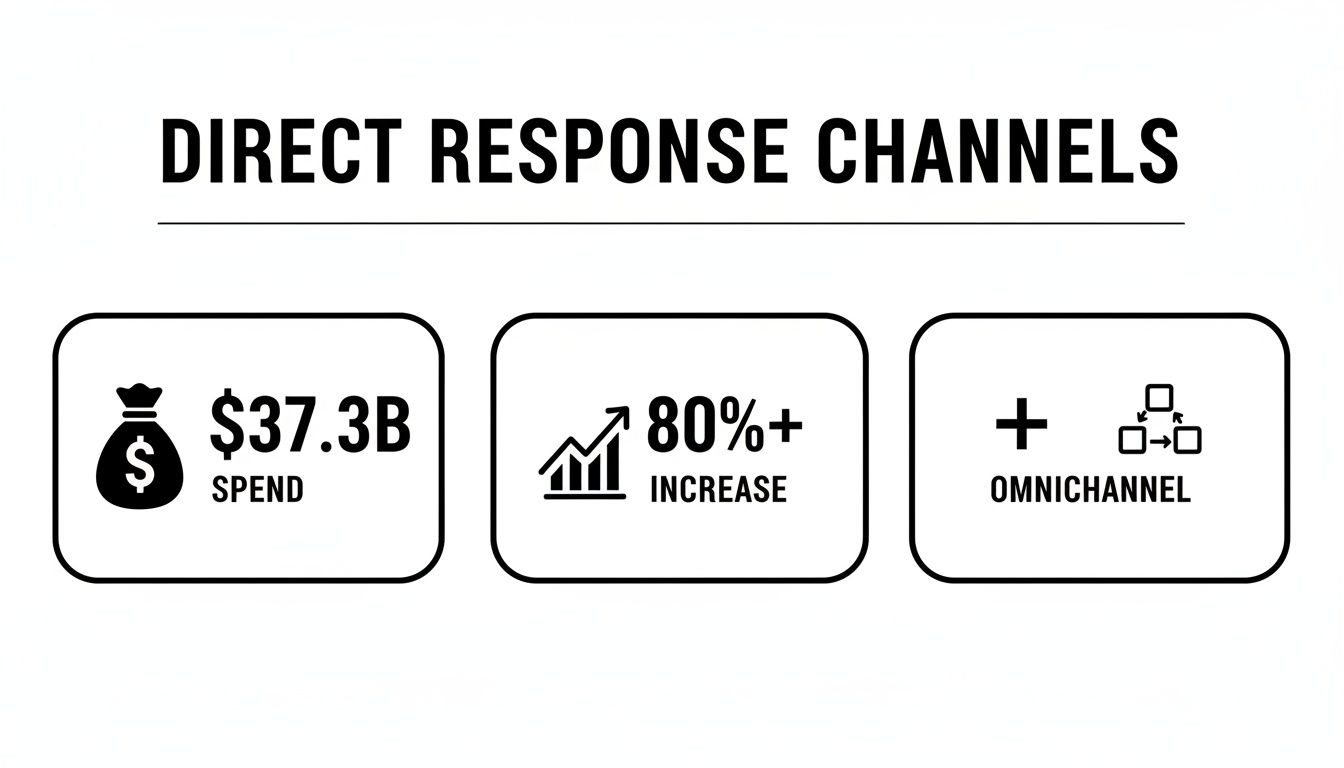
The data speaks for itself: a $37.3B spend and an 80%+ increase in investment shows just how much confidence marketers have in strategies they can actually measure.
If you want to make smart, profitable decisions, you have to get comfortable with a few core KPIs. These are the metrics that form the foundation of any good direct response campaign, helping you optimize what works and cut what doesn't.
Here are the big three you absolutely must master:
By focusing on these KPIs, you stop spending money on marketing and start investing it. Every decision becomes a calculated move designed to generate a predictable return, turning your advertising into a reliable growth engine.
For instance, old-school direct mail still pulls an average response rate of 4.4%, which crushes email’s typical 0.12%. But when you combine it with digital ads, those response rates can skyrocket to 27%. It just goes to show how powerful a measured, multi-channel approach can be.
Knowing how to read and act on this data is what separates the campaigns that fizzle out from the ones that scale to the moon. To get even deeper into the numbers, check out our guide on optimizing your Facebook Ads reporting.

Alright, this is where the theory ends and the action begins. Putting these principles to work and watching the results roll in is easily the most exciting part of direct response.
Launching your first campaign doesn't have to be complicated. In fact, it's better if it isn't. You just need a clear, methodical playbook. We'll break it down into four simple stages, giving you a solid foundation to get started, learn from your data, and scale what works.
Before you write a single word of copy or design a single graphic, you need to know exactly who you’re talking to. Get specific. A vague audience leads to a weak, generic offer, and weak offers get ignored.
Once you know your audience, your job is to craft an offer so compelling it feels like a no-brainer. This isn't just your product—it's the entire package, wrapped in urgency. A great offer makes the decision to act right now feel like the smartest, most obvious choice they can make.
Here’s a simple framework to build your offer:
Your ad has one job: get the click. That's it. Once they click, the landing page takes over to close the deal. A classic rookie mistake is sending perfectly good ad traffic to a busy homepage with a dozen different distractions. In direct response, your landing page needs to have a single, obsessive focus.
The page should feel like a natural continuation of your ad. The headline, the offer, the visuals—they all need to align perfectly to create a smooth, frictionless experience for the user.
Your landing page is not a brochure; it’s a closing argument. Every single element—from the headline to the button color—should be optimized to persuade the visitor to take one specific action.
Strip it down. Remove all navigation links, social media icons, and anything else that could pull the user away from your call-to-action (CTA). Your CTA button should be big, bold, and impossible to miss. Reinforce the offer, handle any potential objections with testimonials or FAQs, and guide the user straight to the conversion.
Now it’s time to get your message in front of the right eyeballs. For digital channels like Facebook, the setup process is pretty straightforward, but you have to pay attention to the details. This is where you connect your audience, your ad creative, and your landing page.
Let’s use Facebook Ads as a quick example:
Getting the tracking right from the start is critical. If you need a more detailed guide, this Facebook Ads Manager tutorial breaks down the entire process step-by-step.
Once your campaign is live, the real work begins. Direct response is a game of constant improvement, and that improvement is fueled by data. This isn't a "set it and forget it" strategy.
Check your core metrics every day. Are you getting plenty of clicks but no conversions? Your landing page is probably the weak link. Is your click-through rate in the gutter? Your ad creative or offer likely isn't hitting the mark.
By watching these numbers, you can start forming hypotheses, run A/B tests on your ads and landing pages, and systematically improve your results over time. This feedback loop—launch, measure, optimize, repeat—is the engine that drives scalable success.
Even when you've got the basics down, a few questions always pop up when it's time to put theory into practice. Let's tackle the most common ones so you can move forward with confidence.
We'll clear up any lingering confusion right now.
Think of it this way: direct response marketing is asking for a sale today. Brand awareness is building a relationship for a sale tomorrow. Their goals are worlds apart, and you measure them in completely different ways.
Direct response lives and dies by immediate, trackable action. Success is purely about the numbers—hard data like your Cost Per Acquisition (CPA) and Return On Ad Spend (ROAS). Brand awareness, on the other hand, plays the long game. It’s about creating a positive feeling around your company, measured with softer metrics like brand recall, social media buzz, and public sentiment.
Absolutely. You could argue it's the perfect strategy for a small business on a tight budget. The whole model is built around accountability. You know exactly which ads are making you money and which ones are just burning cash.
That measurability is a massive advantage. You can start small on channels like social media or search ads, see what resonates, and then confidently double down on the campaigns that are proven to bring in revenue. It takes the guesswork out of marketing and turns it into a predictable engine for growth.
For small businesses, direct response isn't just a strategy; it's a financial lifeline. It ensures every dollar spent on advertising is held accountable, maximizing impact and minimizing waste when every penny counts.
Most failed campaigns can be traced back to a handful of avoidable mistakes. If you can steer clear of these common pitfalls, you’ll dramatically boost your chances of success and make sure your budget is actually working for you.
Here are three of the biggest offenders to watch out for:
At Lix.so, we eliminate the repetitive busywork that slows down your direct response campaigns. Stop building ads one by one and launch your next high-volume creative test in seconds. Start your 7-day free trial and scale your Facebook Ads faster.
Create hundreds of Facebook Ads campaigns in minutes with Lix.so. Batch creative upload, reusable templates, and automatic campaign generation.
✓ Free for 14 days · ✓ No credit card required · ✓ Cancel anytime

