Published by December 19, 2025 · Reading time 22 minutes · Created by Lix.so
Cost per impression rates, often called CPM, are the price you pay for one thousand views of your ad. Think of it like this: You pay a set price for every 1,000 pairs of eyes that see your digital billboard, regardless of whether they click on it. This makes it a foundational metric for measuring the cost-efficiency of brand awareness campaigns.
Imagine you're pinning a flyer to a community bulletin board. You aren't paying for each person who takes one, but simply for the opportunity to have your message seen by everyone who walks past. Cost per impression rates work the same way in the digital world. You're paying for visibility—the chance to get your brand, product, or message in front of a target audience.
This pricing model is one of the oldest and most fundamental in digital advertising. Its roots go all the way back to 1995 with the launch of Cost Per Mille (CPM), the first standardized model for online ads, which arrived just after the web's first-ever banner ad. A few years later, in 1998, the Internet Advertising Bureau (IAB) established a clear definition for an "impression"—when at least 50% of an ad is visible for one second—bringing much-needed consistency to the industry.
Calculating your cost per impression rate is refreshingly simple. The formula gives you a clear snapshot of how much you're spending to capture attention.
The CPM Formula: (Total Ad Spend / Total Impressions) x 1000 = Cost Per Mille (CPM)
Let’s walk through a quick example. Say you spent $200 on a Facebook ad campaign and it generated 50,000 impressions. Your calculation would look like this:
This means you paid $4 for every 1,000 times your ad was displayed. This single number is a powerful diagnostic tool. It tells you, at a glance, how efficiently your budget is being converted into eyeballs on your ads. To really get a handle on the mechanics, it's worth checking out a comprehensive guide to the calculation of CPM in digital ads.
While clicks and conversions often steal the spotlight, impressions are the starting point of the entire customer journey. After all, a person can't click an ad they've never seen. Understanding your cost per impression rates is the first step for several key reasons:
Ultimately, tracking CPM provides a crucial baseline for evaluating campaign performance. It's the first domino in a larger analysis that includes other vital metrics. For a deeper dive into how visibility stacks up against engagement, check out our guide comparing impressions vs clicks to see which metric matters most for your goals.
So, what’s a “good” Cost Per Impression rate? That’s like asking what the perfect temperature is—it completely depends on where you are and what you’re doing. There's no magic number.
A CPM that’s fantastic for a B2B SaaS company targeting executives on LinkedIn would be a five-alarm fire for a DTC apparel brand running ads on Instagram. Your ideal CPM is a moving target, shaped by your industry, the platform you’re on, who you're trying to reach, and even the time of year.
Think of it less as a single number to hit and more as a barometer for your campaign's efficiency in its natural habitat. The first step is understanding the simple math behind it.
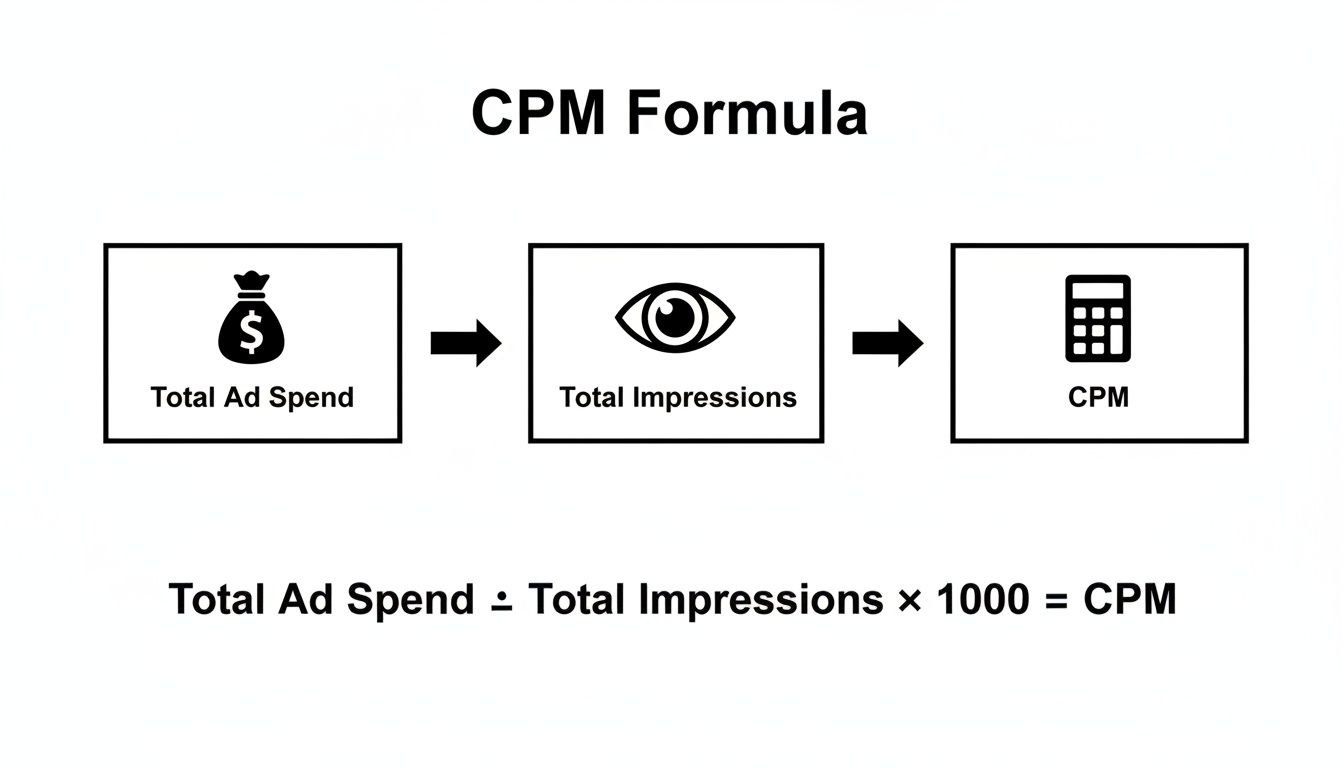
Once you've got that down, you can start to figure out if your costs are in the right ballpark or if there's room to improve.
To get your bearings, you need to look at relevant benchmarks. The cost to get your ad in front of 1,000 people swings wildly from one channel to another, reflecting everything from audience intent to the ad formats available.
Here's a quick look at the typical CPMs you can expect to see across some of the major platforms.
This table gives you a comparative overview of typical Cost Per Impression rates across different digital advertising platforms. Use it to help benchmark your own campaign performance and understand the factors at play.
| Advertising Channel | Average CPM Rate (USD) | Key Influencing Factors |
|---|---|---|
| $11 - $15 | Intense competition, audience targeting, ad placement (Feed vs. Stories) | |
| $7 - $10 | High visual engagement, influencer marketing impact, younger demographics | |
| $6.59+ | Professional targeting (job titles, industries), B2B focus, high-value audience | |
| TikTok | Around $10 | Massive reach, viral content trends, younger audience, lower user intent |
But remember, these numbers are just a starting point. Digging into programmatic ad auctions shows an even crazier variance. Some advertisers get away with paying as little as $0.01, while others bid over $113 for a thousand impressions on the open web. It's a wild world out there.
A "good" CPM isn't about hitting some universal target. It's about being competitive within your specific niche, on your chosen platform, and for your unique audience.
Once you have a feel for the general landscape, the real work starts: digging into your own data. Your CPM is a diagnostic tool. It tells a story about how healthy and efficient your campaigns are.
Start by comparing the CPM across your different campaigns and ad sets. If one campaign has a sky-high CPM compared to the others, it’s time to play detective. Is the audience too narrow? Is the creative just not landing? Pinpointing these variations is where optimization begins. For a real-world look at what good impression rates can achieve, check out case studies like Ad360's success in achieving top vCPM in branding.
Most importantly, never look at your CPM in a vacuum. A low CPM is worthless if it doesn't lead to clicks, conversions, or brand awareness. I'd take a slightly higher CPM that targets a high-converting audience over a rock-bottom rate that generates empty impressions any day of the week.
You have to see the full picture. If you're running ads on Meta, getting a firm grip on your metrics is non-negotiable. You can get a head start by learning more about Facebook Ads reporting and key metrics to understand what’s happening beyond the initial cost.
Ever feel like your CPM rates have a mind of their own, soaring one month and dipping the next? You're not alone. Several key factors are constantly duking it out in the ad auction, creating a dynamic environment where the price for attention is always shifting.
Think of it like booking a flight. The price for the exact same seat can change dramatically based on when you book, the destination, and how many other people want that same flight. Your CPM is no different—it’s a live reflection of supply and demand.

The good news is, the forces driving your rates up or down are predictable once you know what to look for. Let’s break down the most significant influencers one by one.
Who you're trying to reach is arguably the single biggest driver of your impression costs. The more specific and valuable your audience, the more you’ll have to pay to get in front of them. It's a simple case of supply and demand.
Imagine you're targeting high-income executives in the finance industry on LinkedIn. This is a highly sought-after demographic, and countless B2B advertisers are all bidding for their attention. That intense competition creates a bidding war, which directly inflates the CPM for everyone.
On the flip side, targeting a broader audience, like "people interested in outdoor hobbies," will almost always result in a lower CPM. Why? The audience pool is massive, and the competition is far less concentrated.
The Targeting Trade-Off: Hyper-specific targeting often leads to higher conversion rates, but it comes at the cost of more expensive impressions. Broader targeting lowers your CPM, but you might need more impressions to find the right customers. Finding that sweet spot is the name of the game.
Ad platforms like Facebook and Google want to show users content they actually find interesting. To make that happen, their algorithms reward high-quality, relevant ads with better placements and, you guessed it, lower costs.
These platforms assign a relevance score (or a similar quality metric) to your ads based on how users interact with them. Ads that get positive engagement—likes, comments, shares, and high click-through rates—signal to the platform that your content is a good fit. The algorithm then favors your ad in the auction, effectively giving you a discount on your CPM.
Conversely, if your ads are constantly ignored or hidden by users, they get a low relevance score. The platform sees this as a poor user experience and will penalize you with higher CPMs or, in some cases, stop showing your ad altogether.
The digital ad market ebbs and flows with the calendar. Certain times of the year are far more competitive, causing a surge in advertising costs across the board.
The most notorious example is the Q4 holiday season, especially the period from Black Friday to Christmas. Retail and e-commerce brands flood the platforms with massive ad budgets, creating fierce competition for every available impression. This spike in demand drives CPMs through the roof for everyone, even for advertisers in completely unrelated industries.
Other seasonal trends can also have a big impact:
Being aware of these seasonal shifts helps you set realistic budgets and plan your campaigns with your eyes open.
Where your ads are shown—both geographically and on the platform itself—plays a huge role in your costs.
Geographically, advertising in affluent, highly developed countries like the United States or the United Kingdom is way more expensive than in emerging markets. This is due to higher competition and greater purchasing power. An advertiser might pay a $15 CPM to reach users in New York City but only $2 to reach a similar audience in another part of the world.
Ad placement also matters a great deal. Premium spots, like the main Facebook or Instagram feed, command higher CPMs because they get the most visibility. Cheaper placements, such as the right-hand column or Audience Network, are less prominent and typically cost less but may also deliver lower engagement. It's all a balancing act between cost and visibility.
Knowing what drives your CPM up or down is one thing. Actually getting in the driver's seat to control it is another. The real magic happens when you shift from just analyzing your ad performance to actively taking steps to improve it. This is how you turn a good campaign into a great one.
Lowering your CPM isn't about finding one silver bullet. It's about a systematic process of refining, testing, and optimizing every single piece of your ad.
Fortunately, you have way more control than you might think. By zeroing in on a few key areas, you can make your ad budget work harder and stretch every dollar to reach more of the right people. Let's break down the most effective moves you can make today.

Your audience is the bedrock of your entire campaign. If you get it wrong, you’re basically paying a premium to show your ads to people who will never buy. The goal is to hit that sweet spot—not so broad that you're wasting money, but not so narrow that you're driving up competition and jacking up your CPM.
A great place to start is by excluding audiences that are irrelevant or have already converted. Layering interests and behaviors can help, but don't go crazy. Sometimes, a slightly broader, well-defined audience gives the platform's algorithm more breathing room to find your ideal customers at a lower cost.
And don't forget lookalike audiences. They're built from your best customers, but you need to test different levels. A 1% lookalike is super specific, while a 5% lookalike casts a wider net. Testing both can quickly show you which one delivers the best balance of cost and quality for your brand.
In a world of endless scrolling, your ad creative is your single best weapon against high CPMs. Thumb-stopping, genuinely engaging creative gets rewarded by platforms like Facebook and Instagram with higher relevance scores, which directly translates to a lower CPM. It’s simple: an ad people actually want to see is cheaper to show.
Your creative has to grab attention in the first three seconds. No exceptions. This means using:
Remember, the best ads don't feel like ads. The more your content blends in with the native user experience, the better it will perform, leading to positive engagement signals and, you guessed it, lower costs.
An investment in high-quality creative is a direct investment in lowering your ad costs. The more engaging your ad, the less you'll pay to get it in front of people, as platforms will prioritize it in the auction.
Never assume you know what will work. A/B testing is the only real way to find out what resonates with your audience, making it a powerhouse tool for hammering down your CPM. By systematically testing one element at a time, you can pinpoint winning combinations that boost engagement and slash costs.
To get clean data, always test one variable at a time. Here are the big ones to focus on:
This constant cycle of iteration is where the gains are made. But it also creates a huge operational headache for marketing teams: how do you produce enough high-quality creative variations to test effectively without drowning in manual design work? This creative production bottleneck is often the single biggest barrier to unlocking lower CPMs.
On Facebook, getting a handle on your CPM isn't just a smart move—it’s a matter of survival. Millions of advertisers are all vying for the same eyeballs, turning the platform’s ad auction into a fierce battleground where efficiency is everything. The first step to making your budget work harder is understanding exactly what drives your cost per impression on Facebook.
Unlike a simple billboard where the highest bidder wins, Facebook’s algorithm is obsessed with user experience. This means it actively rewards ads that people actually like. Ads with high engagement—the ones pulling in likes, comments, and shares—get better placements and, crucially, lower CPMs. Your ad's quality and relevance have a direct, measurable impact on how much you pay just to be seen.
This creates an undeniable link between your creative performance and your costs. An ad that stops the scroll and gets a positive reaction is fundamentally cheaper to run. On the flip side, a boring or irrelevant ad gets penalized with higher costs, quickly draining your budget for little to no return.
So, the key to unlocking lower costs is relentless A/B testing. But this is where most marketing teams hit a wall. To find those winning combinations of visuals, headlines, and copy, you have to churn out a high volume of creative variations. Trying to build each ad manually, one by one, is a soul-crushing, error-prone process that kills all momentum.
This creative production bottleneck is often the single biggest hurdle standing between you and a lower CPM. Teams know they need to be testing more, but the sheer manual effort involved makes it impossible to do at scale. They end up settling for just a few variations, which means they're working with limited data and missing out on huge optimization opportunities. For more on this, check out our guide covering the different types of Facebook Ads you can create.
Advertising costs on Facebook are anything but predictable. Rates can swing dramatically based on seasonality and competition. Looking back, the fluctuations have been wild. In 2015, CPMs might have hovered around $5-7 during peak shopping seasons like Black Friday.
Fast forward to more recent data, and you see social media CPMs surging to $9.91 in November, dropping to $6.90 in July, then rocketing back up to $11.84 in September. That's a 97% jump from the summer lows, driven by holiday and back-to-school campaigns. While global social media CPMs were recorded at $6.06 in late 2023, competitive markets like the US often see prices 20-50% higher.
This volatility makes an agile creative process absolutely critical. When costs are high, you need your absolute best-performing ads running just to stay profitable. When costs are low, you need to be able to scale up fast to seize the opportunity. Advertisers who get this right—often using dynamic creative—have reported CPMs up to 25% lower than their competitors. You can dig into more insights about the evolution of Facebook ad costs on Uphex.com.
This is exactly where tools built for efficiency change the game. Instead of burning hours manually uploading assets and building campaigns in Ads Manager, you can automate the whole thing. A platform like Lix.so becomes your creative scaling engine, letting you turn a folder of images or videos into a full-blown A/B test in seconds.
By removing the manual labor from campaign creation, you free up your team to focus on what truly matters: strategy and creative iteration. This shift is fundamental to lowering your cost per impression rates.
With the power to launch dozens of creative variations effortlessly, you can suddenly:
By solving the production bottleneck, you create a powerful feedback loop. More testing leads to better creative, which drives higher engagement, which in turn results in a lower CPM. This newfound efficiency allows you to stretch your budget further, reach more people for the same spend, and ultimately drive much better results for your business.
Once you get the hang of the basics, you'll find that the world of CPM is filled with nuance. It's less about hard rules and more about context. To help you navigate those "what if" moments, we've tackled some of the most common questions marketers ask.
Think of this as your cheat sheet for managing impression-based campaigns with confidence.
Not necessarily. While a low CPM looks fantastic on a report, it can sometimes be a red flag. The real goal isn't just to get cheap impressions; it's to get cost-effective impressions in front of the right audience.
An unusually low rate might mean your ad is being shown in low-visibility placements that nobody actually sees or to an audience that has zero interest in what you're selling. This leads to thousands of impressions that generate no clicks, no engagement, and no brand recall. It’s like buying a billboard on a deserted road—sure, it's cheap, but it’s not doing you any good.
Always weigh your CPM against other key metrics like Click-Through Rate (CTR) and conversion rate. A slightly higher CPM that reaches a high-intent audience is almost always more valuable than a rock-bottom CPM that reaches everyone and no one at the same time.
These three acronyms are just different ways to pay for advertising, each tied to a specific goal. Think of them as different tools for different jobs.
CPM (Cost Per 1,000 Impressions): You pay for eyeballs. This is your go-to for brand awareness campaigns where the main objective is to get your message seen by as many relevant people as possible.
CPC (Cost Per Click): You pay for traffic. This model is perfect for campaigns designed to drive people to your website or a specific landing page. You only get charged when someone actually clicks your ad. The average CPC for Facebook ads is around $1.72, but this varies wildly by industry.
CPA (Cost Per Acquisition): You pay for results. Here, you're focused on a specific action, like a sale, a lead form submission, or an app download. Since you only pay when a user converts, it’s the ideal choice for performance-driven campaigns.
The right model depends entirely on what you're trying to achieve. Building brand recognition? CPM is your metric. Need to drive sales? That’s where CPA shines.
A "good" CTR really depends on your industry. What’s considered an engaging ad in one sector might be just average in another. According to industry-wide benchmarks, the average CTR for Facebook ads across all industries is 0.90%.
But the numbers can swing dramatically from there:
These figures show why context is king. An apparel brand aiming for a 1% CTR has a realistic goal, while an employment service hitting that same number would be crushing its industry average.
Absolutely. Ad fraud is a massive problem that can completely distort your performance metrics and drain your budget. When it comes to CPM, this fraud often takes the form of bots or automated scripts generating fake impressions on your ads.
This means you’re paying for "views" that were never seen by a real human. Your reported impression count gets inflated, which can make your CPM look normal or even low. But in reality, your effective CPM—what you're actually paying for real human views—is much, much higher.
To protect your campaigns, it's crucial to:
Staying vigilant against ad fraud ensures your budget is spent connecting with real customers, not lining the pockets of fraudsters.
Ready to stop wasting time on manual ad creation and start scaling your creative testing? Lix.so replaces the tedious process of building campaigns with a powerful, automated workflow. Upload dozens of creatives in seconds, reuse your best-performing campaign structures with templates, and launch bug-free campaigns instantly. Cut your build time from hours to minutes and focus on the strategy that drives down your cost per impression rates.
Create hundreds of Facebook Ads campaigns in minutes with Lix.so. Batch creative upload, reusable templates, and automatic campaign generation.
✓ Free for 14 days · ✓ No credit card required · ✓ Cancel anytime

