Published by December 22, 2025 · Reading time 24 minutes · Created by Lix.so
Running Facebook ads for dropshipping is a classic playbook for a reason—it works. It can drive a flood of targeted traffic and sales, but only if you get the technical foundation right. Before a single dollar leaves your ad account, you absolutely must install the Meta Pixel and Conversions API.
Getting this backend setup dialed in is non-negotiable for running profitable campaigns in today's privacy-focused world.
Think of your ad account's technical setup as the plumbing for your entire advertising machine. If it’s leaky or poorly connected, everything that comes after—your targeting, your optimization, your scaling—will be built on a shaky base.
So many dropshippers rush this stage. It’s a classic rookie mistake that leads to nothing but wasted ad spend and data you can't trust. Taking an hour to configure these elements correctly is the first real step toward building a predictable, scalable business.
The two pillars of this foundation are the Meta Pixel and the Conversions API (CAPI).
The Meta Pixel: This is a small piece of code that you place on your website. It tracks what users do (view a product, add to cart, buy something) and sends that info back to Meta from their browser. It's the original workhorse for retargeting and measuring campaign results.
The Conversions API (CAPI): This is the modern, server-side counterpart. Instead of sending data from the user's browser, it sends it directly from your server to Meta's. This creates a much more reliable data connection that can't be easily blocked by ad blockers or browser privacy settings like iOS updates. In 2024, CAPI isn't optional; it's a requirement for accurate tracking.
Key Takeaway: The Pixel and CAPI are designed to work together as a team. When the Pixel gets blocked (and trust me, it happens a lot), CAPI acts as a backup, making sure your conversion data still gets to Meta. This gives the algorithm a much fuller, more accurate picture of what's actually working.
Once your tracking tools are in place, the next immediate step is to verify your domain inside Meta Business Manager. This is basically you proving to Meta that you own your store's website. It’s a simple process that unlocks critical features and builds a layer of trust with the platform.
After verification, you have to configure your Aggregated Event Measurement. This is Meta's system for handling data from iOS 14+ users, and it forces you to prioritize which conversion events you care about most.
For any dropshipping store, the event priority is pretty straightforward. You'll want to set it up like this:
By setting this hierarchy, you’re telling Meta's algorithm what to focus on when it has limited data to work with. Get this configuration right, and you're ensuring your budget is spent finding people who will complete your most valuable actions.
If you want to go deeper on this, our guide on tracking ads on Facebook breaks down the entire process in more detail. Mastering this technical setup isn't just a box to check—it's the bedrock of every successful dropshipping ad strategy.
Alright, with the technical setup handled, let's get into the fun part—building the actual campaign architecture that's going to make you money. Forget the old-school advice about creating dozens of tiny, micro-managed ad sets. That's a surefire way to burn yourself out.
The modern playbook is all about blending the raw power of Meta’s machine learning with smart, controlled testing. It's a game-changer for dropshipping because it simplifies everything while pushing performance through the roof.
The core idea is simple: a dedicated campaign for scaling your winners and a separate one for finding your next winner.
The structure that top dropshippers swear by today is surprisingly simple. You only need two campaigns running at the same time, each with a very clear job.
Advantage+ Shopping Campaign (ASC): This is your main engine. Your scaling machine. You feed this campaign your best-performing, proven ad creatives, and Meta’s AI takes the wheel. It uses its massive dataset to hunt down new customers at the lowest possible cost. Think of it as your "greatest hits" playlist that runs 24/7.
Ad Set Budget Optimization (ABO) Campaign: This is your lab. Your testing ground. In an ABO campaign, you control the budget at the ad set level, which is perfect for testing new products, new audiences, and new creatives with small, manageable budgets. Once you find a winner here, you "graduate" it over to the big leagues—your ASC campaign—and let it scale.
This two-pronged approach gives you the perfect balance: the granular control of an ABO campaign for efficient testing, and the automated horsepower of an ASC campaign to scale profitably without you having to touch it every five minutes.
This model keeps your ad account clean and your strategy crystal clear. You're either testing or scaling. No confusion.
Your audience strategy isn't something you set once and forget. It evolves as your store gathers more data. When you're just starting out, you don't have much to go on, so the best move is to let the algorithm do the heavy lifting for you.
Start with broad targeting. Seriously. This means you create an ad set with almost no targeting layers. Maybe you'll set an age range, gender, and location, but that's it. No interests. This gives Meta's algorithm maximum freedom to explore and find pockets of customers you would have never guessed existed. It’s a powerful way to let real data, not your assumptions, lead the way.
Once your pixel is seasoned with purchase data—I’m talking at least 100+ purchases—you can start getting a lot more sophisticated.
Lookalike Audiences: These will become your most valuable assets, hands down. You can create lookalikes from your customer list or, more commonly, from people who have triggered your "Purchase" pixel event. A 1% Lookalike audience will be the most similar to your original customer base and is almost always the best place to start for finding new, high-intent buyers.
Interest-Based Audiences: These are perfect for your ABO testing campaign. You can test a single, hyper-specific interest (like "Camping Gear") or stack a few related ones together (like "Hiking" + "Outdoor Life" + "Patagonia"). This is how you validate if a product resonates with a specific niche and discover entirely new customer segments.
The dropshipping world is exploding. Valued at $445.5 billion in 2025, it's projected to hit an insane $1,253 billion by 2030. That kind of growth means more competition, making a razor-sharp audience strategy non-negotiable.
Having a dialed-in audience approach is what separates the stores that thrive from those that fizzle out. If you want to go deeper on this, we've got a whole guide on how to uncover killer audience insights on Facebook.
Alright, you've got your campaign structure mapped out. Now we get to the fun part—the single most important variable that will make or break your Facebook ads for dropshipping: your creative.
In a feed crowded with distractions, a mediocre ad is completely invisible. But a great ad? A great ad can make even a broad, untargeted audience profitable from day one. It's that powerful.
Think of your creative—the blend of your visual (image or video) and your ad copy—as your digital salesperson. It has about three seconds to stop the scroll, spark curiosity, and convince someone to click. No amount of fancy targeting or budget wizardry can save a boring ad.
The good news is you don't need a Hollywood budget. You just need to understand a bit of human psychology and follow a proven formula that speaks directly to impulse buyers.
While polished images and carousels can work, nothing I've seen consistently outperforms authentic, user-generated content (UGC) style video. These ads don't feel like ads. They look like a post from a friend, which instantly lowers a potential customer's guard.
This inherent trust is why they're so effective. The data backs it up, too: shoppers who watch product videos are 1.81x more likely to purchase. That number alone should convince you to make video your main focus. Your goal is to create short, snappy videos that show the product solving a real-world problem.
Pro Tip: Forget hiring expensive influencers. The best "UGC" often comes from ordering the product yourself and filming simple, problem-solving clips with your smartphone. Authenticity almost always crushes high production value in this game.
To make your videos hit hard and fast, structure them around the classic "Hook, Story, Offer" framework. It's a simple three-act play designed for short attention spans.
The Hook (First 3 Seconds): This is everything. Your only job here is to stop the scroll. You can do this by showing a dramatic "before and after," asking a provocative question, or featuring the product solving a problem in a visually interesting way. Make it impossible to ignore.
The Story (Seconds 4-12): This isn't a long-winded tale. It's a rapid-fire demonstration of the product's top 2-3 benefits. Show, don't just tell. Instead of saying a portable blender is "powerful," show it demolishing a handful of ice in seconds.
The Offer (Final 3 Seconds): End with a crystal-clear call to action (CTA). This means a verbal cue like "Shop now to get 50% off!", bold text overlays announcing the discount, and a good reason to act now.
This formula works because it delivers the punchline before the viewer has a chance to get bored. If you're looking for more creative ideas, it's worth exploring the different types of Facebook ads that are proven to work for e-commerce.
Your ad copy is the wingman to your creative—it’s there to close the deal. Forget long, chunky paragraphs nobody will read. We're talking short, punchy sentences, emojis to break up text, and bullet points for easy scanning. Remember, over 98% of users are on mobile, so scannability is key.
Here’s a simple but effective copy structure I use all the time:
This one-two punch of a scroll-stopping visual and clear, benefit-focused copy is the engine that drives consistently profitable dropshipping ads on Facebook.
Finding a winning ad isn't a lottery; it’s a disciplined, systematic process. This is the part of the game that separates the profitable dropshipping stores from the ones that just burn cash. The whole point is to find winning creatives and audiences as efficiently as possible, using a clear structure and data-driven rules.
Forget about throwing random ads at the wall to see what sticks. We're going to build a dedicated testing lab using an Ad Set Budget Optimization (ABO) campaign. This setup gives you precise control, letting you assign small, specific budgets to each audience you’re testing. No single ad set can run away with all the money.
A solid, battle-tested starting point is the 1-4-2 structure. It's simple: one campaign, four different ad sets, and two unique creatives in each of those ad sets.
Start with a small daily budget—think $5 to $10 per ad set. This is plenty to gather the initial data you need without risking your shirt. You're not trying to strike gold on day one; you're buying data to learn what your market actually wants.
This methodical approach ensures you’re testing variables one by one, making it dead simple to see which audience-creative combos are showing promise right out of the gate. From here, it's all about watching the right numbers.
It’s easy to drown in a sea of metrics inside Ads Manager. To stay sane and make smart decisions, you really only need to focus on a few key performance indicators (KPIs) that tell you the most important parts of the story.
To keep things clear, here’s a breakdown of the metrics I live by during the testing phase, along with some realistic benchmarks for dropshipping.
| Metric | Good Benchmark | What It Tells You |
|---|---|---|
| Click-Through Rate (CTR) | > 2% | Shows if your ad creative (visual + copy) is grabbing attention and making people stop scrolling. A low CTR is your first red flag. |
| Cost Per Click (CPC) | < $1.00 | Measures how efficiently you're driving traffic. A low CPC means you're getting more eyeballs on your product page for less money. |
| Cost Per Add to Cart (ATC) | Varies, but watch trends | This is a crucial mid-funnel metric. It signals that your ad, product, and price are compelling enough to create real purchase intent. |
| Return on Ad Spend (ROAS) | > 2.0 (Breakeven+) | The ultimate measure of profitability. If you're spending $1 and making $2 back, you're on the right track. This is your north star. |
These benchmarks are a starting point, not gospel. Some niches will have higher CPCs but also higher average order values. The key is to understand what each metric is telling you about the customer's journey from the ad to the checkout.
Facebook ads are still a powerful channel for dropshippers. The industry sees an average click-through rate of around 2.5% and an average cost per click of just $0.60, making it a very accessible platform to test new products. You can find more data on Facebook ad cost benchmarks to see how you stack up.
The Golden Rule: Let your ads run for at least 3-4 days before you touch anything. Performance can be a rollercoaster in the first 48 hours. You need to give the algorithm time to learn and gather enough data—ideally spending at least 2-3 times your target Cost Per Purchase—to make a call you can stand by.
Here are some simple, data-backed rules I use for managing my testing campaigns. No emotion, just numbers.
This simple flowchart breaks down the creative formula that consistently pulls in sales during testing.
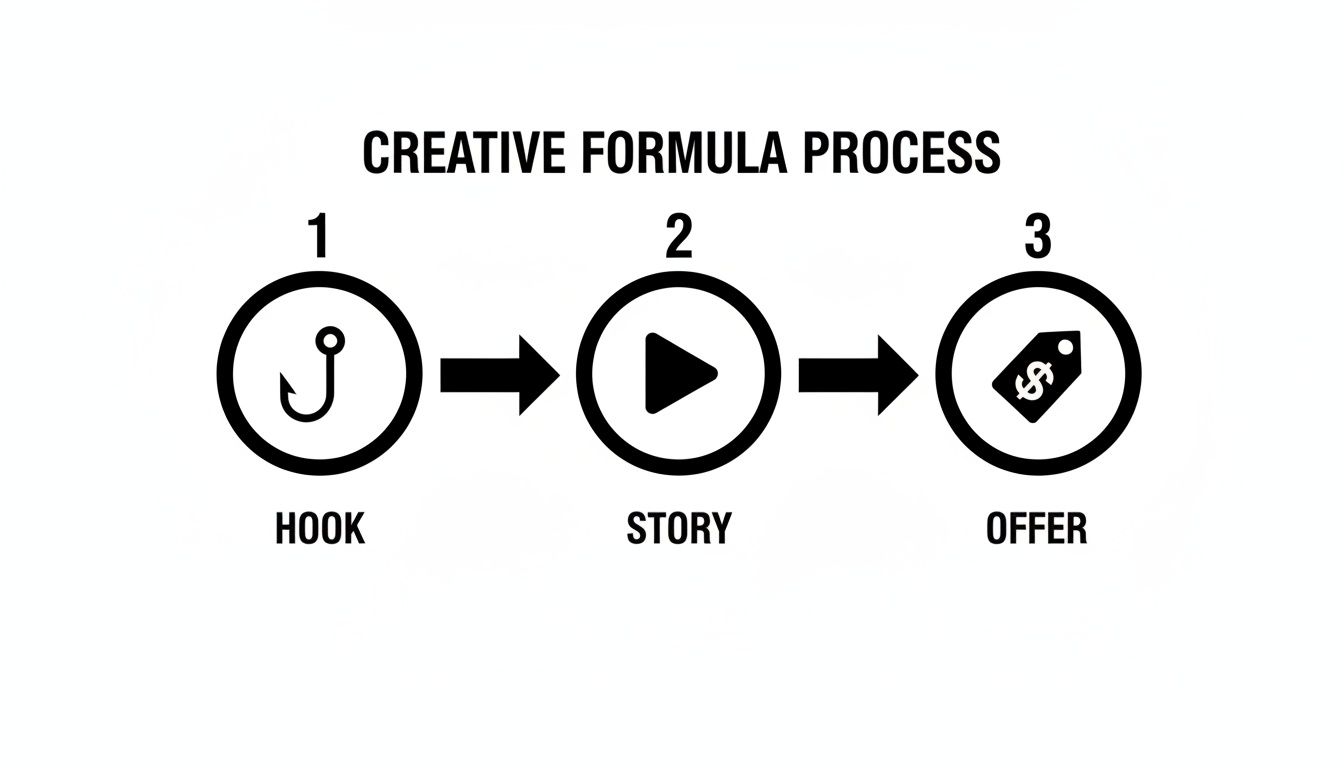
This Hook, Story, Offer process is the backbone of almost every high-converting ad. It grabs their attention, tells them why they need the product, and gives them a clear, compelling reason to buy now.
Once you find an ad set that delivers a consistent ROAS above your breakeven point, you’ve found a winner. It's time to move it out of the testing lab and into the scaling phase.
That feeling when you finally find a winning ad in your testing campaign? It's incredible. But that's just the start. The real money in dropshipping is made when you scale—that's where you strategically pour fuel on the fire, reaching thousands of new customers without your Return on Ad Spend (ROAS) completely falling apart.
But scaling isn't just about cranking up the budget on a winning ad set and crossing your fingers. That's a rookie mistake that almost always resets Meta’s learning phase, tanks performance, and burns through your cash.
Instead, think of scaling as a methodical process built on two core strategies: vertical and horizontal scaling. Knowing which one to use, and when, is the key to actually growing your store profitably.
Vertical scaling is the simplest way to get more out of a winner. You take an existing, profitable ad set and just… give it more money. The key word here is gradually. You want to feed the algorithm a bigger budget without shocking it into a panic.
The safest, most common rule here is the 20% daily increase rule. Let's say you have an ad set humming along at a $50 daily budget. Tomorrow, you can bump it to $60. If it stays profitable, you can increase it by another 20% the day after that. This slow-and-steady method keeps the ad set stable and avoids triggering another dreaded learning phase.
Key Takeaway: Vertical scaling is perfect for squeezing more performance out of a proven ad set. It’s reliable and low-risk, but it has a ceiling. Eventually, you’ll hit a point of diminishing returns where a higher budget just means a lower ROAS.
This is where you find massive growth. Instead of just giving one ad set more money, you take your winning ad creative and show it to brand-new audiences. You're essentially cloning what works and launching it into new territory.
This is how you tap into entirely new pockets of customers. Here are the most effective ways to do it:
Horizontal scaling lets you multiply your success across Meta's enormous user base. It’s how you go from spending $100 a day to $1,000 a day and beyond, all while keeping things profitable.
The ultimate scaling move? Graduating your proven creatives from your ABO testing campaign into your main Advantage+ Shopping Campaign (ASC). Your ASC is your scaling powerhouse, built to let Meta's AI do what it does best: find customers at scale, efficiently.
Once an ad creative has proven its worth in testing—meaning it has a stable, positive ROAS over a few days—you simply add it to your Advantage+ campaign. That's it. From there, Meta’s algorithm takes over, automatically finding the best placements and audiences to maximize your sales. This is the simplest and most powerful way to handle Facebook ads for dropshipping at a high level.
Don't underestimate the power of this platform. Facebook's influence on social commerce is huge, swaying over 60% of US shoppers to make a purchase. With a user base of over 3 billion people, the potential for scale is practically limitless. By moving your winners into an ASC, you're plugging your best assets directly into that massive ecosystem. You can check out more eye-opening dropshipping statistics on AutoDS to see the full scope of the opportunity.
Jumping into the world of Facebook ads for dropshipping can feel like trying to drink from a firehose. You’re hit with a barrage of new terms, competing strategies, and mountains of data. It's totally normal to have a ton of questions, especially when your own money is on the line.
Think of this section as your no-BS guide. We're cutting through the noise to give you direct, practical answers to the real problems and roadblocks dropshippers face every single day. We’ll cover everything from how much you actually need to get started to the infuriating problem of getting clicks but zero sales.
There's no single magic number, but a smart, safe starting point is somewhere between $20 to $50 per day.
Now, you have to frame this correctly in your mind. This isn't profit-seeking money; it's data-buying money. Your only job at this stage is to purchase information from Meta's algorithm.
A classic, battle-tested approach is to set up an ABO (Ad Set Budget Optimization) campaign. You could run four different ad sets, each with a tiny $5 daily budget. That’s a total daily spend of $20, which is more than enough to start testing different audiences and creatives without risking your shirt.
The mindset here is everything. You are not trying to be profitable on day one. Your only mission is to find the combination of product, creative, and audience that shows a spark—a glimmer of potential. Once you spot a combo with a positive ROAS, that's when you flip the switch and start thinking about profitability and scaling.
Ah, the classic. This is hands-down the most common and frustrating problem you'll face. But here's the good news: if your ad is getting clicks, it's doing its job. The breakdown is happening after the click, which means the problem is on your website.
Here are the prime suspects to investigate right now:
Dig into your website analytics. Look at the bounce rate and the average time on page for traffic coming straight from your ads. Those numbers will tell you exactly where your customer journey is falling apart.
Understanding this is absolutely key to running ads on Meta today.
A manual campaign, often using ABO or CBO (Campaign Budget Optimization), is where you are the pilot. You're in the cockpit, manually picking your targeting (interests, behaviors, lookalikes) and setting budgets for each ad set or the whole campaign. This granular control makes manual campaigns perfect for your testing phase, where you need to isolate variables to see what works.
An Advantage+ Shopping Campaign (ASC), on the other hand, is Meta's AI co-pilot. You feed it your winning creatives, give it a budget, and provide some high-level signals (like your existing customer list). Then, you hand over the controls. Meta's algorithm takes over, hunting down the most likely buyers across its entire universe of apps. ASC is built for one thing: scaling.
The pro move is to make them work together. Use manual ABO campaigns as your lab to find winning ads and audiences. Once you've found a proven winner, you "graduate" it into an ASC campaign to scale it up efficiently.
Patience is a superpower in this game, especially when you're testing. You have to give an ad enough time and money to escape the chaotic "Learning Phase" and gather some real data. Making knee-jerk decisions after a day or two is a recipe for disaster, as performance can swing wildly.
A solid rule of thumb is to wait until an ad set has at least 2,000-3,000 impressions or has spent 2-3 times your target Cost Per Purchase.
Always, always look at performance trends over a 3-4 day window before making the final call. This data-driven approach takes the emotion out of it and leads to much smarter decisions.
Ready to stop building campaigns from scratch and start launching in seconds? Lix.so is your unfair advantage. Upload dozens of creatives at once, apply reusable campaign templates, and publish directly to Meta without the soul-crushing manual work. Cut your build time from hours to minutes and get back to focusing on strategy and growth. Start your 7-day free trial of Lix.so today and see how fast you can really move.
Create hundreds of Facebook Ads campaigns in minutes with Lix.so. Batch creative upload, reusable templates, and automatic campaign generation.
✓ Free for 14 days · ✓ No credit card required · ✓ Cancel anytime

